Tuesday, November 15, 2016

Art and Feminism

I was so fascinated by those articles.  Honestly I was surprised that those issues are real.  I can't believe that forcing a woman to undress on the beach is allowed.  It is interesting too that all of this talk surrounds women's dress.  It reminds me of this political cartoon:
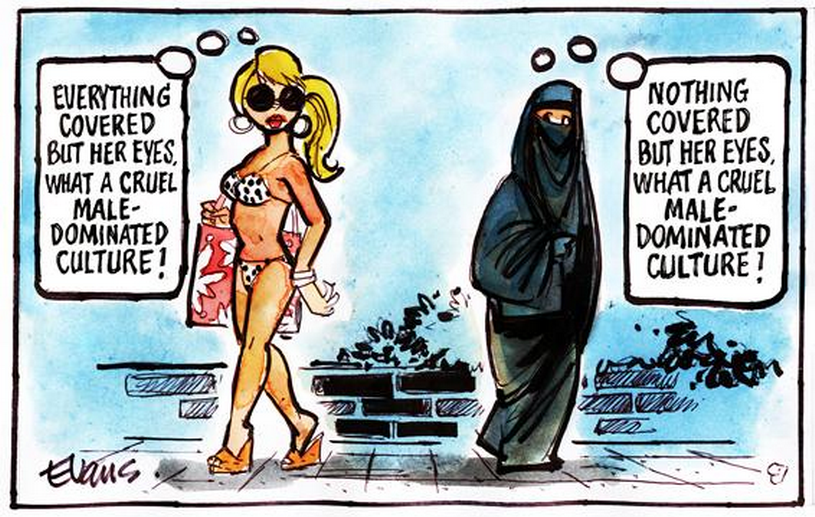
Image result for political cartoon muslim woman bikini
It also makes me question and look into feminism and art and the ways that we "should" respond.  With an issue like this... I honestly don't know how to respond.  I don't think I particularly like the bikini culture, but do I think that women's swimwear should be limited and controlled by someone?  Probably not.  But what if women don't want to wear any clothing at all?  Does it ever come to close to that?  What kinds of gender issues are we dealing with here?  I honestly don't feel like I understand the complexity of those issues.  

When I consider feminism in art I find the different waves of feminism most fascinating.  The first wave said "there is a problem here" and their method of solving it was to flaunt femininity.  It tried to solve the problem of male dominance in the art world.  The first wave of feminism flaunted the woman's body, its curves, its reproductive cycles and everything.  Second wave feminism realized that that was most likely perpetuating the issues and tried to correct it.  In some ways when I look at the problem illustrated in these articles I feel some sympathy towards those early feminists.  I feel like I don't know how to respond.  Woman and men are different.  The way we deal with them in society is different.  So what now?  Do we regulate what women can and can't do?  Do we treat them like we treat men?  Do we cover them up?  Do we flaunt them?  I don't know the answer, and I find myself proceeding with caution because I know how easily the pendulum can swing when we see a problem.  I don't think it is right to tell a Muslim woman that she can't where a burkini on the beach.  I don't know why political, social, and religious difficulties manifest themselves in women's clothing but, I do know that there is a problem and that we should carefully consider each side.  What are we perpetuating?  Why are we doing this?  What does it imply for everyone?  


Monday, November 7, 2016

UMOCA

I went to the UMOCA for the first time for this assignment!  I was so thrilled and I went ready to appreciate some contemporary art.  I walked into the first little room and I was kind of pleased by it.  There were these odd figures and these screen prints on newsprint that you could take with you.  Me and my brother took these ones.

  The walls were painted, which I liked and her subject matter felt somewhat lighthearted.  She was talking about every day life and she had what felt like a light-hearted video piece.  I enjoyed it, it seemed playful and thought provoking even though I wished I could hear her talk about her own work.  

There was an interesting feeling video piece of someone in gold dancing through a landfill with a gold gas mask on, to the tune of "I'm singing in the rain."  The message to that felt pretty clear.  I went to another room where they had a collaborative mural of women who were maybe missing from history, who should have been noticed more.  The photographs of the artists were spread throughout the room.

Unfortunately... I felt like my visit was kind of downhill from there.  I don't know if that was a result of me feeling sometimes disenchanted with art, but I just started to feel like... what is the point?

I work at the MOA and we have copyright issues with a lot of contemporary artists, so I kind of assumed I couldn't take pictures.  I did begin to take pictures of what I really found interesting though, and that was honestly the writing on the plaques on the walls.  I found myself curating a curious collection of words and what felt like kind of weird evidence of contemporary art and our ideals and our emphasis.  My curation felt kind of like my own art piece.
 The piece above is one that I found particularly interesting and that made me feel a lot of frustration.  Scared around the room were green and yellow troughs.  I was looking at troughs that really didn't remind me of humans at all.  They weren't the same size and they didn't help me think about what the plaque said they should.  My younger brother came with me, and he was particularly startled by the wording of this plaque.  He was amused that they put "processes of ingestion" instead of eating.  The interpretation that I made of this piece was that we were meant to think about our bodies and everything goes into them.  It might compare our eating to that eating that animals do in preparation to become our food.  It might compare their job, down in the dirt and eating from a lowly trough, to ours.  I think that they were trying to make the point that no matter who we are we are a part of that and it shapes our identity.  I felt frustrated because without the plaque I never would have understood that, and with the plaque it was still difficult for me to work my way past the jargon, if not because some of the sentences made no sense, just out of pure annoyance for that kind of block that they put up for some reason.


I don't know if this was the experience that I was supposed to have but I felt kind of like... why do we make art?  What was the purpose of this?  And that was kind of an uncomfortable feeling for me.  I wanted to be floored by the art, but I instead left feeling disenchanted with contemporary art.  I felt like there wasn't a purpose to the things that I had seen and if there was the artists were selfishly keeping that from me through their jargon and their attempts to be everything at once.  Industrial and domestic.  Rigid and soft.  I thought about a reading that I had to do in one of my classes about a dancer who learned when she got too old to dance that she could gain a lot from giving to her dancer that could still dance.  Sometimes I feel like these artists are hoarding instead of giving.  I know they don't need to spell it out... but I just felt frustrated by the experience of going there.  

Saturday, October 29, 2016

Final Test Question1


It's interesting to look at this images which it seems like were largely an exercise and to consider them from the lens of different views.  I keep finding myself fascinated by the different things that we view as correct.  How can we all think so differently about things and what is real and true?  If we consider the perspective of a modernist they would view these images for their aesthetic and formal value only.  They would think about the image in itself and not consider the context in which it was made, they would think about color theory as far as how the colors work together (their interactions based on the different backgrounds), how the forms fit, and whether or not the image stands on its own.  They would consider abstraction for what it is and look at the images for their medium.  A postmodernist would consider these images in context of how they were created.  They might consider the implications of black and white and might even consider the modernist attitudes that we took in creating the images and what kind of context that brings.  They would not consider color theory in a modernist sort of way, assess the colors and their relationship with each other, but they would consider them in a postmodern way.  Think about the implications of skin color, of black and of white, of one skin tone in relation to the background on which it is set.  The context provided and even the collection of images would make them think of color theory in a much more cultural and political kind of way.  They would consider how colors have been viewed, how we thought of them when they made them and what they mean in the context of today.

I would ask my students these questions:

Does art have to have meaning?
Are you a modernist or a postmodernist?
How are you a modernist and how are you a postmodernist?


Dan Barney

Dan Barney talked to us about speculative realism and Object Orientology.  A lot of what I learned is that artists consider and learn from all things.  There aren't certain outcomes that are inherent with different objects, we could do macaroni art that's classic and lame or we could do macaroni art that is awesome.  We should always ask ourselves what an object can teach us.  We should help our students to question things too.  We also looked at an Art 21 video from Vancouver that I really enjoyed.  I liked that the artist began making things because he couldn't help it, they were a part of who he was because of who he was and the culture he was raised in as well as the culture that he wasn't raised in.  Even though the art that he made had a great deal of weight and content behind it, it was interesting to me that he wasn't afraid to depart from that and maybe just make sculptures out of shoes, that didn't relate to his original idea.

Then we went to see Rebecca Campbell's exhibit in the MOA.  It was interesting for me to approach it again with a new crowd because I work in the MOA.  I've approached it by myself.  I've been trained on it.  I've read descriptions of it a thousand times and given tours of it.  I've talked about it with random patrons or with my coworkers.  It was interesting to discuss it with people that maybe come from a similar artistic standpoint as me and to consider it.  It's interesting how I feel pressure to conform to other people's opinions no matter who it is I'm talking to.  A lot of times I feel a pressure to think similarly to them as if there is a right way to think in order to gain acceptance or to just be right.

Tuesday, October 25, 2016

Jethro

Jethro's presentation was awesome.  I never cease to be amazed by what High School Students can do when they are put in the right environment.  Jethro talked a lot about his portable gallery, he also showed us some of his current work and honestly a lot of it made me feel like... I want to be more of an artist than I am now before I teach.  I've been feeling really nervous that I won't be able to help my students be artists because I don't know if I know how to be one.  We talk a lot in classes like Curriculum about setting up an environment, creating a formula instead of a recipe.  I love thinking about these things and I'm passionate about education, and about art.  But I just don't know HOW to create the right environment.  I loved hearing Jethro talk about all of the things that he's doing.  I loved seeing the work that he's creating right now, and how he helps his students help with it sometimes.  I loved hearing about the ownership that people are taking of their own work.  Making a show.  Advertising it.  Setting it up and making arrangements for that on their own.  His students really take ownership of their work and I think that is so amazing!  I just sometimes feel intimidated because I see what I want to be able to do, but I don't know how to do that on my own.

Tuesday, October 11, 2016

War

http://www.art21.org/videos/episode-protest

Nancy Spero -7:50-9:30
An-My Le - 14:02-16:10
Alfredo Jaar - 29:18

How do these three artists compare?  What is their main objective?  How do they accomplish it?  Should we comment about things like war that are so complex?  Why even add our voices?  What's the point?

How do we respond to the world as artists?  Do we have to know what we're talking about before we can talk about it?

I was considering how I could respond to questions like this about a topic like war, and really all I could think of was the very few and far removed experiences I have had regarding war.  The first time I felt like I could understand a little bit of what war might do to affect me personally - here in America, far away from the wars that have been going on - was when my after only a short time dating my fiance told me that he had thought about going into the military.  It was a weird new kind of reality to me.  I had never ever considered that that would be something that would happen to me.  It's interesting to see how my perspective has changed as I have come to hear and see some of the effects that war had on one family.  My response is unlike any of the three pieces above.  It was more of a personal reflection.  This is a picture of my fiance when his dad was deployed for over a year.  It represents my own coming to grips with the idea of war and sacrifice.


Tuesday, October 4, 2016

Cornell West, Bell Hooks, and Michel Foucault

What are they saying?  This blog post needs more time.  But here are some things that they are saying.

“Never forget that justice is what love looks like in public.” 
― Cornel West

“My aim is not to provide excuses for black behavior or to absolve blacks of personal responsibility. But when the new black conservatives accent black behavior and responsibility in such a way that the cultural realities of black people are ignored, they are playing a deceptive and dangerous intellectual game with the lives and fortunes of disadvantaged people. We indeed must criticize and condemn immoral acts of black people, but we must do so cognizant of the circumstances into which people are born and under which they live. By overlooking these circumstances, the new black conservatives fall into the trap of blaming black poor people for their predicament. It is imperative to steer a course between the Scylla of environmental determinism and the Charybdis of a blaming-the-victims perspective.” 
― Cornel WestRace Matters

“As all advocates of feminist politics know most people do not understand sexism or if they do they think it is not a problem. Masses of people think that feminism is always and only about women seeking to be equal to men. And a huge majority of these folks think feminism is anti-male. Their misunderstanding of feminist politics reflects the reality that most folks learn about feminism from patriarchal mass media.” 
― bell hooks

“Visionary feminism is a wise and loving politics. It is rooted in the love of male and female being, refusing to privilege one over the other. The soul of feminist politics is the commitment to ending patriarchal domination of women and men, girls and boys. Love cannot exist in any relationship that is based on domination and coercion. Males cannot love themselves in patriarchal culture if their very self-definition relies on submission to patriarchal rules. When men embrace feminist thinking and practice, which emphasizes the value of mutual growth and self-actualization in all relationships, their emotional well-being will be enhanced. A genuine feminist politics always brings us from bondage to freedom, from lovelessness to loving.” 
― bell hooks

“Justice must always question itself, just as society can exist only by means of the work it does on itself and on its institutions.” 
― Michel Foucault