I tended to like the pieces of art that surprised me. I've also been thinking a lot about Annie Poon and her work and for some reason I find myself liking a lot of things that look kind of illustrative recently. Here were two that I found surprising, they weren't the typical hyper realistic drawing that you see sometimes in art shows and so they stood out a lot to me.
Wednesday, March 8, 2017
Monday, February 6, 2017
Curriculum Sketch
Figure
Drawing: Body and Soul
Essential
Questions
What is drawing? Where did it start?
Is there value in figure drawing? What does the figure represent?
How does our body relate to our soul? How is the silhouette
important? How are our bodies represented?
Rationale
What do I really want them to be able to do?
I want them to think critically about drawing. Within their own
practice, within the history of the world, the way we think about humans,
within the history of art. How has it’s importance changed over time?
How has it stayed with us? There are ideas about humanism, about
classical drawing and what art education should be. There are so many
things to consider. Why do we draw the body?
Learning
Goals
Knowledge
Base
Silhouettes: Kara
Walker. http://www.art21.org/artists/kara-walker
Michelangelo’s David
Michelangelo’s Sistine Chapel the later period when he started
even adding muscles that aren’t even there. “Last Judgment”
Leonardo da Vinci’s studies
Neoclassicism, why did we keep coming back to that ideal?
Fashion illustrators: ?
Janine Antoni “Loving Care”
Heather Hansen https://www.youtube.com/watch?v=C4oBc-o1npg
Learning
Activities:
Make a drawing - first
let the students draw anything.
Figure drawing
Drawing with sticks
Drawing from fashion
illustrators
Drawing from the masters
Doing anything (from
what we have done so far)
Drawing as an explorer
as an excavator.
Drawing with tools.
Drawing with machines
The Big Project
Figure drawing: Drawing with your body somehow. Needs to be
a work that you spend a certain amount of time on.
Wednesday, February 1, 2017
What do you do as an artist?
What is the relationship between your experiences and ongoing artistic work to your curriculum and teaching. How do you describe what you do as an artist.
It's hard to draw lines between my experiences, and work as an artist and my curriculum and teaching because I feel my curriculum and teaching aren't living and breathing yet. So far my curriculum is hypothetical and my teaching experience is very little. The curriculum I have written has a lot to do with things that I'm passionate about, especially in regards to my interaction with high school students. I want them to think about communication and language and their interaction with others. Those are the things that I think about and the things that I make art about. I keep a running list of "art ideas" that I get as I think about different things throughout the day. There are things that I want to do and explore and so I hope that my artistic work lives and breaths with my life and then my curriculum and teaching live and breathe along with my artistic practice.
As an artist, I honestly don't feel totally sure what I do. People often ask you when they find out you're an artist. "What kind of art do you do?" "Do you draw, do you paint, do you do portraits, do you do landscapes?" It's funny, at the MOA the other day I gave a tour to some Deseret Book employees who had just gone over to see our faculty show. We stood at the entrance to a religious exhibit and they asked me "What kind of art that was" that they had just seen. I tried to talk a little bit about process and concept with them and they seemed somewhat baffled. I don't think the faculty art show fit their idea of art. So what kind of art do I do? I think I do... the kind that I have time for. I wish I had a year where I could do nothing but think about and make art and take time to develop all of the parts of me that I want to. Right now I feel like I'm the kind of artist that is barely able to put out enough art for her classes but wishes she could make more and invest more. If I had to talk to an administrator about what I do most I would probably say that I'm a painter, that I can draw, that I can do printmaking, that I want to do more in social practice art. Reading our book made me squirm just a little bit because I felt like I wasn't anywhere close to an "expert" in any area.
Monday, January 23, 2017
First day of school and drawing
On the first day of school I want to help my students deconstruct the first day of school and their conceptions of art.
We'll start with a getting to know you activity. We'll maybe start with a conventional getting to know you activity where each student asks the person next to them the conventional questions.
"What is your name?"
"Where are you from?"
"What do you like to do?"
I'll then spend some time deconstruction the first day of school, starting out with a discussion of what students expect from me on the first day of school. We might make a list on the board. I'd expect it'd say "going over the syllabus, getting to know you activities, introductions, etc."
We'll then talk about the process of getting to know someone, and why we often start it the same way. Why do we ask the same questions? Are those things important to them? Do we even remember them? What do you want people to know about you? What do you want to really know about someone else?
We'll then do an activity where everyone will write a question and send it in to me. I will answer the questions (unless they are inappropriate).
Next we'll take a test! This will be a Dr. Graham test. I want to ask them questions like this:
What is an artist?
What will happen in this art class?
What makes an art class a good art class?
What makes a teacher good?
I'm considering putting a scale on there that looks like this:
And having them rate themselves on the scale:
Not artist -----------------------------------------------------------------------------Artist
Then I'll have them answer the question of why they are or are not artists. We will deconstruct this idea next time.
Now onto the topic of DRAWING.
I do think it's important to teach drawing. Whether or not drawing is going to be a main part of each student's art practice or not, I think drawing connects us to art history and to the art discipline. I think for me, most importantly drawing teaches us to see. I would want a drawing foundation course to be about that. About learning to see the world around you. I think it is important for them to grapple with representational and observational drawing. I think it's also important for them to explore conceptual drawing. I want them to expand drawing past their original conceptions. I want them to break their idea of "artist" and "not artist" and also consider what it is that makes art important or relevant. I also want them to spend a significant amount of time drawing things that are relevant to them. I want them to really consider what is significant to them and then make iterations and push themselves further. I want them to deconstruct the world through drawing.
Tuesday, January 17, 2017
Springville
I honestly have quite a difficult time looking at spiritual art. I feel this inner conflict about how to handle it. I don't know if I should judge it, give in to the representational and/or cliche things that might be depicted, or if I should even treat it the way that I treat contemporary art.
One thing I do know is that when I look at spiritual art I definitely feel the reality of the pressure I feel to like or dislike something. I kind of find myself wondering if I'm allowed to like or dislike something and I have a hard time letting go of that pressure. These were non-representational and so they felt safer to judge than a large image of Christ. I like the colors and shape and feel of the first one, and then I wonder if that was a correct judgment of it or not.
This piece is similar.
Then there are other things that I like but I'm not quite sure if it's because I've been conditioned to think that it's a certain way or not. I thought that this was an interesting piece because it freshened my perspective of Alma 32 without painting a little picture of a seed growing and writing faith in swirly letters next to it (which I have probably done at some point in my life). I felt refreshed by it. It breathed new life into those chapters for me.
This one made me feel similarly. I felt refreshed by it. The artist felt genuine to me.
Then finally there are a number of things that I like but I don't like and I'm not sure why. I can feel the pressure that comes from the general population. Her hands and face and clothing are beautifully painted, they are realistic. And then I read the plaque and I can't help but be drawn in by the story, it's the kind that you find in the Ensign. It's only a short little blurb but it has the power to draw you in, rip your heart out, and amaze you all at the same time. I'm not sure if I like it or if I just like the principle that is being taught by it. I'm not quite sure if I should call it good art or not, but in my heart I feel like it's not supposed to be good art. So I'm not sure how to consider it.
This representation of the Savior I actually did kind of like, but again I feel a little part of me wondering if I'm allowed to.
There was also a part of me that liked something like this. I have no idea how accurate the clothing style or portrayal really is, but I do think it's beautiful to contemplate Christ and Mary when Jesus was a tiny baby.
It's really a difficult thing for me to grapple with. I wonder if part of me is a little bit resistant to give into either party. When I see 97% of the population (or at least the Mormon population) falling in love with most of these paintings, especially a certain kind of painting, I feel resistant to it. When I see something that I (and others) like in my art classes, I feel conflicted. Part of me resists giving in to what everyone likes and the other part of me is confused about what I really like.
Tuesday, November 15, 2016
Art and Feminism
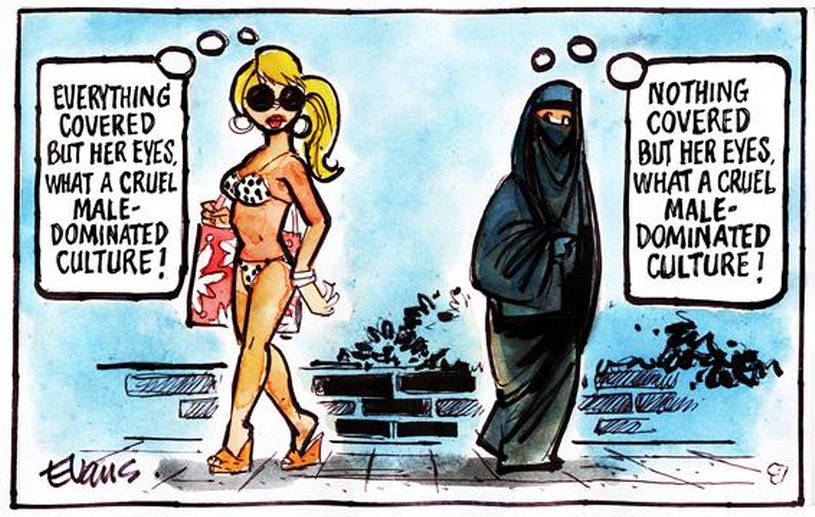
I was so fascinated by those articles. Honestly I was surprised that those issues are real. I can't believe that forcing a woman to undress on the beach is allowed. It is interesting too that all of this talk surrounds women's dress. It reminds me of this political cartoon:

It also makes me question and look into feminism and art and the ways that we "should" respond. With an issue like this... I honestly don't know how to respond. I don't think I particularly like the bikini culture, but do I think that women's swimwear should be limited and controlled by someone? Probably not. But what if women don't want to wear any clothing at all? Does it ever come to close to that? What kinds of gender issues are we dealing with here? I honestly don't feel like I understand the complexity of those issues.
When I consider feminism in art I find the different waves of feminism most fascinating. The first wave said "there is a problem here" and their method of solving it was to flaunt femininity. It tried to solve the problem of male dominance in the art world. The first wave of feminism flaunted the woman's body, its curves, its reproductive cycles and everything. Second wave feminism realized that that was most likely perpetuating the issues and tried to correct it. In some ways when I look at the problem illustrated in these articles I feel some sympathy towards those early feminists. I feel like I don't know how to respond. Woman and men are different. The way we deal with them in society is different. So what now? Do we regulate what women can and can't do? Do we treat them like we treat men? Do we cover them up? Do we flaunt them? I don't know the answer, and I find myself proceeding with caution because I know how easily the pendulum can swing when we see a problem. I don't think it is right to tell a Muslim woman that she can't where a burkini on the beach. I don't know why political, social, and religious difficulties manifest themselves in women's clothing but, I do know that there is a problem and that we should carefully consider each side. What are we perpetuating? Why are we doing this? What does it imply for everyone?
Monday, November 7, 2016
UMOCA
I went to the UMOCA for the first time for this assignment! I was so thrilled and I went ready to appreciate some contemporary art. I walked into the first little room and I was kind of pleased by it. There were these odd figures and these screen prints on newsprint that you could take with you. Me and my brother took these ones.
The walls were painted, which I liked and her subject matter felt somewhat lighthearted. She was talking about every day life and she had what felt like a light-hearted video piece. I enjoyed it, it seemed playful and thought provoking even though I wished I could hear her talk about her own work.
There was an interesting feeling video piece of someone in gold dancing through a landfill with a gold gas mask on, to the tune of "I'm singing in the rain." The message to that felt pretty clear. I went to another room where they had a collaborative mural of women who were maybe missing from history, who should have been noticed more. The photographs of the artists were spread throughout the room.
Unfortunately... I felt like my visit was kind of downhill from there. I don't know if that was a result of me feeling sometimes disenchanted with art, but I just started to feel like... what is the point?
I work at the MOA and we have copyright issues with a lot of contemporary artists, so I kind of assumed I couldn't take pictures. I did begin to take pictures of what I really found interesting though, and that was honestly the writing on the plaques on the walls. I found myself curating a curious collection of words and what felt like kind of weird evidence of contemporary art and our ideals and our emphasis. My curation felt kind of like my own art piece.
The piece above is one that I found particularly interesting and that made me feel a lot of frustration. Scared around the room were green and yellow troughs. I was looking at troughs that really didn't remind me of humans at all. They weren't the same size and they didn't help me think about what the plaque said they should. My younger brother came with me, and he was particularly startled by the wording of this plaque. He was amused that they put "processes of ingestion" instead of eating. The interpretation that I made of this piece was that we were meant to think about our bodies and everything goes into them. It might compare our eating to that eating that animals do in preparation to become our food. It might compare their job, down in the dirt and eating from a lowly trough, to ours. I think that they were trying to make the point that no matter who we are we are a part of that and it shapes our identity. I felt frustrated because without the plaque I never would have understood that, and with the plaque it was still difficult for me to work my way past the jargon, if not because some of the sentences made no sense, just out of pure annoyance for that kind of block that they put up for some reason.
I don't know if this was the experience that I was supposed to have but I felt kind of like... why do we make art? What was the purpose of this? And that was kind of an uncomfortable feeling for me. I wanted to be floored by the art, but I instead left feeling disenchanted with contemporary art. I felt like there wasn't a purpose to the things that I had seen and if there was the artists were selfishly keeping that from me through their jargon and their attempts to be everything at once. Industrial and domestic. Rigid and soft. I thought about a reading that I had to do in one of my classes about a dancer who learned when she got too old to dance that she could gain a lot from giving to her dancer that could still dance. Sometimes I feel like these artists are hoarding instead of giving. I know they don't need to spell it out... but I just felt frustrated by the experience of going there.
Subscribe to:
Posts (Atom)